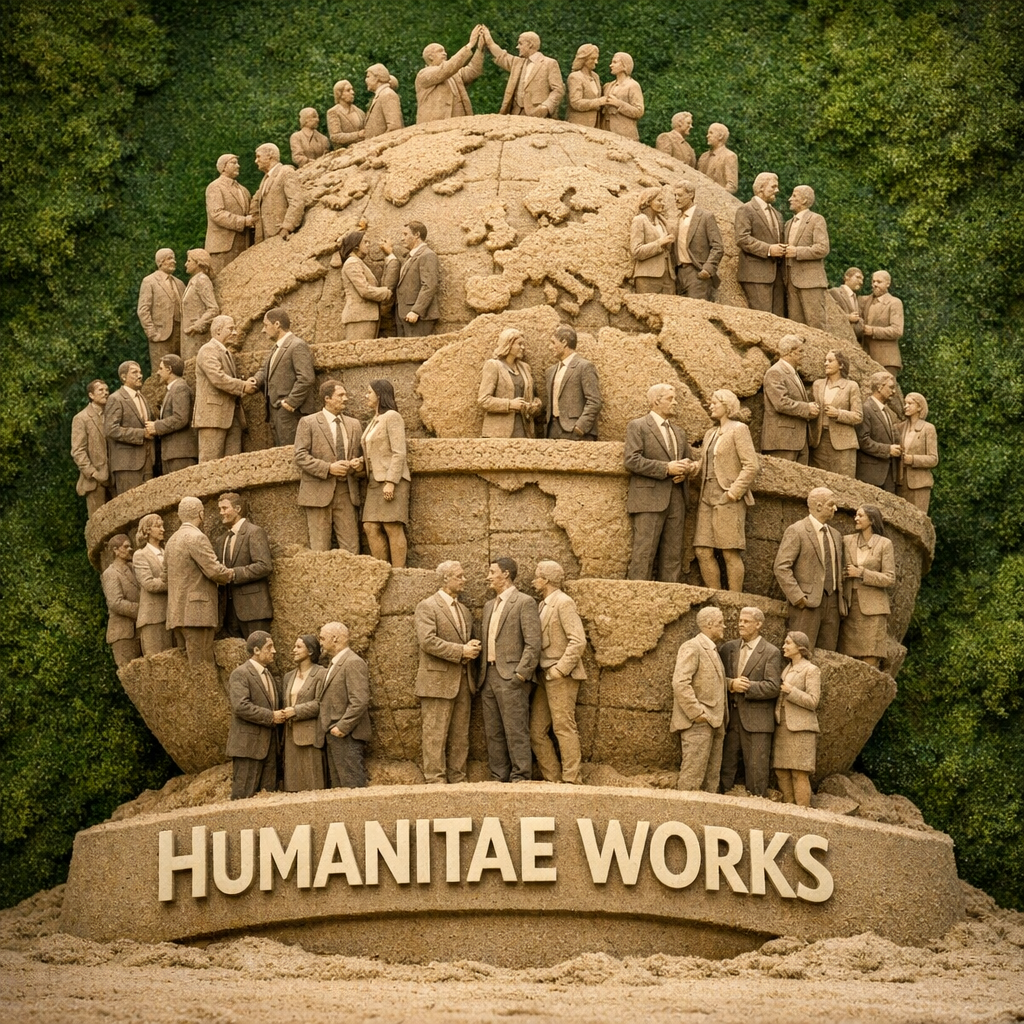
The same ordinary material everybody else has.
Most people walk on the sand and leave a footprint.
Others create masterpieces.
What are you going to do?
Start here
Imagine a Monday where the best of somebody walks in with them.
Not their output. Them — the judgement they have, the care they
take, the idea they nearly did not say out loud. Imagine that arriving on its own,
every week, with nobody being asked to try harder.
That is not a mood, and it is not luck. It is what people do
when they are well enough to do it.
Why it does not happen on its own
Everybody knows school was built for the factory. Almost nobody says the rest of it.
1830s — the school
Mass schooling as we still recognise it was designed for the industrial
age: arrive on time, sit in rows, move through in batches by age, do as you
are told. Bells. Uniform output. It worked perfectly for the thing it
was built for.
1911 — the workplace
Frederick Winslow Taylor published The Principles of Scientific
Management: thinking belongs to managers, doing belongs to workers, and a
worker is a pair of hands that ought to be interchangeable with any other
pair. Most jobs are still shaped by that sentence.
That was 115 years ago, and the belief underneath
it never left the building.
The people who do the work are still treated as a cost to be
managed. A necessary evil. Never the asset — and certainly never the greatest
one.
Which leaves one question that is very hard to
answer out loud. You spend more on these people than on anything else you
own. More than the building, the software, the fit-out, the brand. So why
would you not build them the most beautiful place on earth to do it in?
What a business actually runs on now
- Judgement, in the moment, with nobody senior in the room.
- Somebody saying the difficult true thing early, while it is still cheap.
- Somebody noticing what nobody thought to ask them to notice.
- Care taken over work that no one would have checked.
- An idea offered by the person least expected to have one.
Not one of those comes from a pair of hands. Every one of them
comes from a whole person — and only when they are well.
What this is
The quality of an organisation is decided by the quality of the human beings inside it.
Not their qualifications. Whether they understand how their behaviour lands on
somebody else, what their own responsibility is in a shared space, and how to arrive
whole rather than performing being fine.
It is not compliance training and it is not a resilience workshop.
It is not an app, a stipend, or a fruit bowl. Those are things an organisation buys so
it can say it did something.
HUMANITAS
The Roman word for the complete quality of being fully human — education,
culture, compassion, the civilising of how we behave toward one another. There is
no gender anywhere in its root.
humanity
What centuries of linguistic drift did to it, picking up man along the
way.
HUMANITAE
Taking it back to what it was. The name is the argument.
The Three
Three, and together they hold everybody.
Introit · the sacred act of arrival into a new space
Onboarding
Every new employee, from the first week, before anybody has
learnt who to avoid.
- How long
- 13 weeks, one hour a week, done at work
- What it covers
- Who I am when I walk in · How I land on other
people · Taking responsibility · Not taking it home
The certificate belongs to the employer — dated, named and
verifiable from day one.
Dignitas · the inherent worth that demands to be honoured
Works
Every existing employee, for the relationship with work that
calcifies quietly over years.
- How long
- 26 weeks, one hour a week, one whole-organisation rollout
- What it covers
- Fatigue · Aggression and harassment ·
Traumatic events · Remote and isolated work · Values and conscience
· Organisational justice
The certificate belongs to the employee — theirs, and it
travels with them to every workplace after this one.
Philotimo · love of honour, doing right from love not from fear
For Leaders
Everybody who holds power over another person, calibrated to how
much of it they hold.
- Who
- Middle management · senior leadership · the
C-suite, each with its own content
The certificate belongs to the leader — a credential that
actually means something.
Why this is happening now
Psychosocial safety became law, and almost nobody has changed anything.
Since December 2025 every employer in every Australian state and territory carries a
legal obligation to actively manage psychosocial risk — seventeen named hazards in
the Safe Work Australia Code of Practice. The United Kingdom, Canada, New Zealand and
the European Union have equivalent or emerging law. The United States is moving the
same way.
Most organisations will meet it with a policy document. A policy
does not change what happens in a room on a Tuesday, and everybody inside the
organisation knows that before the ink is dry.
This is not a legal shield that happens to look like culture. It is a genuine
cultural shift that happens to satisfy the obligation — and that order
matters, because the people inside can always tell which one they are being handed.
And one for whoever is reading this
Five questions. You can answer four of them straight away.
- What are you doing to make the world better?
- What are you doing for the people who work for you?
- What are you doing for the community you are in?
- What are you doing for your clients?
- What are you doing for you?
It is lonely at the top, and nobody has ever built the person up there
anywhere private to answer the last one. We are building it. If that landed somewhere,
say so when you write.
Humanity. The best of what we are. In action.
One workplace where people understand what they do to each other changes every
household attached to it. That is a few hundred dinner tables, from one organisation,
inside a year — and it is how a thing like this actually travels.
Start A Conversation